|
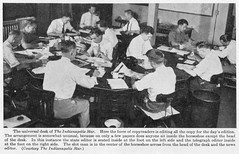
| A newspaper copy desk rim and slot long before computers. |
When I worked as a news copy editor in The Record's Hackensack newsroom, my chair and computer were near the door to the men's room.
That seemed appropriate, because too many of the stories we handled were so poorly done, they were the equivalent of shit -- this from the perspective of having been a prize-winning reporter at The Record and two other daily papers.
I spent many years near the men's room door, processing hundreds of stories by reporters good and bad. I worked with so many assistant assignment editors, I have forgotten all their names, but many of them had one thing in common -- they themselves were mediocre reporters who became mediocre editors and who often knew nothing about the towns their reporters were covering.
Some of the men in the newsroom had appalling bathroom habits. I did my major business at home, but others would disappear into the bathroom with a newspaper, and the noises I could hear were distracting, to say the least. The men's room also needed a system to freshen the air after each toilet flush, but never got it.
But if some of the reporters and editors who used the men's room were slobs, a couple of my colleagues weren't ashamed to do their thing in public, and gross out their desk mates in the process.
One, across the desk from me, had chronic flatulence, and all the other copy editors could smell his gaseous output, but no supervisor ever spoke to him about the problem. For a number of years, he was supervised by his ex-wife. To make matters worse, this copy editor was given supervisory duties, even though he was among the least productive on the desk. He is still employed as a copy editor.
The copy editor who sat behind me often picked his nose and fell asleep -- sometimes with his finger still in his nose. The supervisor, or slot, occasionally had to wake him to complete a file and write a headline so we could make deadline.
The news copy editors worked at night, and there was a clear divide between the day and night staffs. The local news assignment desk, headed for many years by Editor Deirdre Sykes, did its best to thwart the copy desk.
One way was to hold onto a story until a few minutes before deadline to prevent the the copy desk from doing much more than spell-check the text. Sykes specialized in this, along with her peels of laughter that prompted homicidal thoughts in nearby layout editors.
Reporters and their fragile egos were defended no matter how incomplete or how inaccurate or how poorly written their stories were. The assignment desk hated the copy desk, because copy editors were a daily reminder of all the errors the reporters and their supervising editors made, all the garbled writing, all the long and winding lead paragraphs.
It was not uncommon for a reporter covering Englewood or another town to misspell the names of officials, get street names wrong and leave out major information. I lived in Englewood for many years and knew the city better than any reporter or editor in the newsroom.
In the nearly two decades I lived in that city, The Record never reported on the noise from an open-air police firing range, which was used hundreds of days a year and woke residents as early as 8 a.m. with gunshots and shotgun blasts.
When Staff Writer Deena Yellin was assigned to do a round-up on such police ranges a few years ago, the published story omitted any mention of the one in Englewood, despite having been edited by Assistant Assignment Editor Christina Joseph, who once covered Englewood herself, as did Sykes when she was a reporter for a weekly.
Editor Francis Scandale was brought in from the Denver Post in 2000 or 2001, and it soon became clear he wanted the copy editors to write great headlines that would sell newspapers, and not to do much more. He even told them to stop calling reporters after they went home about such problems as misspelled names and inaccuracies.
The copy desk was regarded as a scrap heap for older employees. In all my years there, no copy editor was ever promoted to the job of assistant assignment editor.
The paper was so dysfunctional, it had trouble printing and delivering the paper on time, and kept on making the deadline earlier and earlier to accommodate press malfunctions and inclement weather, which would slow the rag-tag fleet of vehicles used by independent deliverers.
Not only was the paper unable to print late sports scores or the results of municipal night meetings, but copy editors often had one to two hours before the end of their shift at 12:45 a.m. with nothing to edit (yet they were denied a dinner break earlier in their shift because of the tight deadlines).
They, and their supervisors, would use the time at the end of the night to play computer solitaire, write personal e-mails, and plan vacations.
I began free-lancing for the paper's Food section in 1999, and in later years, I would write major pieces or Dining Out on $50 restaurant reviews at the end of my shift, and ask a colleague to look them over before sending them to the food editor. I stopped writing food stories in mid-2006.
I was fired in May 2008 during a downsizing that claimed many veteran employees. After the copy desks of The Record and Herald News were combined, the decline of copy editing continued. Now, inaccurate and dull headlines appear regularly, as do typos and garbled writing, even in lead paragraphs, and stories are published with crucial information missing.
One example occurred just last week, when a 12-year-old boy was killed by an NJ Transit train along an unfenced stretch of track in Hackensack. None of the coverage mentioned he was walking home because Hackensack doesn't provide school busing to students.
What else can you expect when the former Hackensack daily is being run by a flawed journalist, Scandale, and a bunch of lazy assignment editors who refuse to give copy editors -- with their experience and superior knowledge of North Jersey -- the power they have at many other newspapers.